
South Texas Drought Threatens Water and Way of Life
By Berit Mason
Additional research contributed by Kaylin Ledford
Aquifers are bodies of rock, sand, gravel, or sandstone, saturated with water, in and around them. They are not underground rivers or lakes.
The 2022 Water Use Survey shows about 55% of Texas water resources are groundwater (aquifers), 42% are rivers, streams, and lakes (surface water), while 4% is recycled.
With most of our water coming from an aquifer, it’s no wonder meteorologists cite the levels daily, and they have been on a wild ride. In May alone, the Edwards Aquifer Authority (EAA) was at Stage 4, falling to Stage 5, rising back to Stage 4 on May 29th, when rains came. You can’t fool Mother Nature, but she sure can fool us.
The Edwards Aquifer Authority (EAA) stage guide displays varying levels of waterflow, and their corresponding restrictions.
Roland Ruiz is the General Manager of the EAA. He says despite spring showers, we’re years behind the needed rainfall. “We need a season of rain,” he says. And rainfall patterns are going in the wrong direction.
“Over the past century, rainfall has increased in South-Central Texas, but the trend over the past 30 years is negative,” says State of Texas climatologist John Nielsen-Gammon, Director of the Southern Regional Climate Center. “Climate change can change rainfall amounts and patterns.”
A close-up of Edwards Aquifer limestone (courtesy Edwards Aquifer Authority)
EAA stages and San Antonio Water System (SAWS) stages are different. An EAA Stage 5, for example, signifies that aquifer water levels are below 625 ft., measuring the amount of water in the aquifer. SAWS stages are the rules restricting water use, like Stage 3 Restrictions, where households are allowed to water once a week in the early mornings or late at night.
SAWS Director of Communications Anne Hayden says water conservation runs contrary to a homeowner’s desire for a thick green lawn. “It used to be a typical house did not come with a sprinkler system; these days, almost every new house comes with a sprinkler system.” Hence, SAWS staffers go out, looking for anyone breaking water rules, according to the water conservation stage the city is in. “We go out to businesses and neighborhoods and look for infractions of the rules,” says Hayden. “We always have to witness conservation violations.” Violations have sent people to court, but now they appear as fines on your SAWS bill.
Even at EAA board meetings, “over-pumpers,” aquifer permit holders who pump from the aquifer, must answer to a stern 17-member EAA board when using more than their fair share.
Late spring and early summer, the U.S. Drought Monitor map showed the searing dark red of extreme drought in the U.S. Southwest, including Southwest Texas. Thus, this spring’s 2025 89th Texas legislature saw politicians scramble to pass water infrastructure bills. The Texas Senate approved legislation allocating $1 billion on new infrastructure and water pipes to buy cities’ water, also approving the transportation of water from rain-soaked counties to parched southwestern ones.
Outside the suburbs’ hissing summer lawns is the far more serious world of Texas agriculture.
“Ranchers and land managers have conservation methods in play no matter the weather conditions,” says Texas and Southwestern Cattle Raisers Association’s Paige Holbrook. “Without the land and natural resources, they lose their livelihood.” The May 2025 theme of their magazine, The Cattleman, was water.
Farm and ranch lands rely on water wells, but in drought, those wells may emit fewer gallons per minute.
Even the Trump administration strong-armed Mexico to make good on a 1944 US-Mexico water treaty.
“The recovery of Rio Grande Valley agriculture will take time after years of hardship,” says the president of the Texas Farm Bureau, Russell Boening. “The immediate deliveries of water, and the deliveries of water in the next six months, will be critical for farmers and ranchers.”
One method being touted to conserve water is regenerative farming.
“Texas is getting drier every year,” according to Trinity University’s Dr. Kelly Lyons, a PhD in ecology.
“Exotic annual grasses, annual ryegrass, [and] winter wheat are creating much drier soil conditions.” Lyons says regenerative farming keeps greater levels of vegetation cover, so less moisture evaporates from the soil.
“The best way to sustain soil water content is to keep the soil organic matter levels high.” Today’s nutritionists worry that poor soil quality means our food lacks proper vitamins and minerals.
The Texas ‘drought of record’ was 1949 to 1957. These were the 2nd, 3rd, and 8th driest years ever, “the most costly and one of the most devastating droughts in 600 years.” It taught Texas tough lessons.
In the 1990s, the state legislature created the EAA that spanned eight counties, from Uvalde up to Austin. The Comal and San Marcos springs are under its jurisdiction, part of our water supply.
“They’re critical because those two communities, New Braunfels and the city of San Marcos, have grown up and developed around those two spring systems,” says Edward’s GM Ruiz. Arriving to share in that water are the nine million new residents who have moved to Texas since 2000.
Scientists at the Texas Water Development Board have been busily figuring out 50-year plans for our regional and state water supply.
Texas man-made lakes are also reservoirs, holding pens for rainfall.
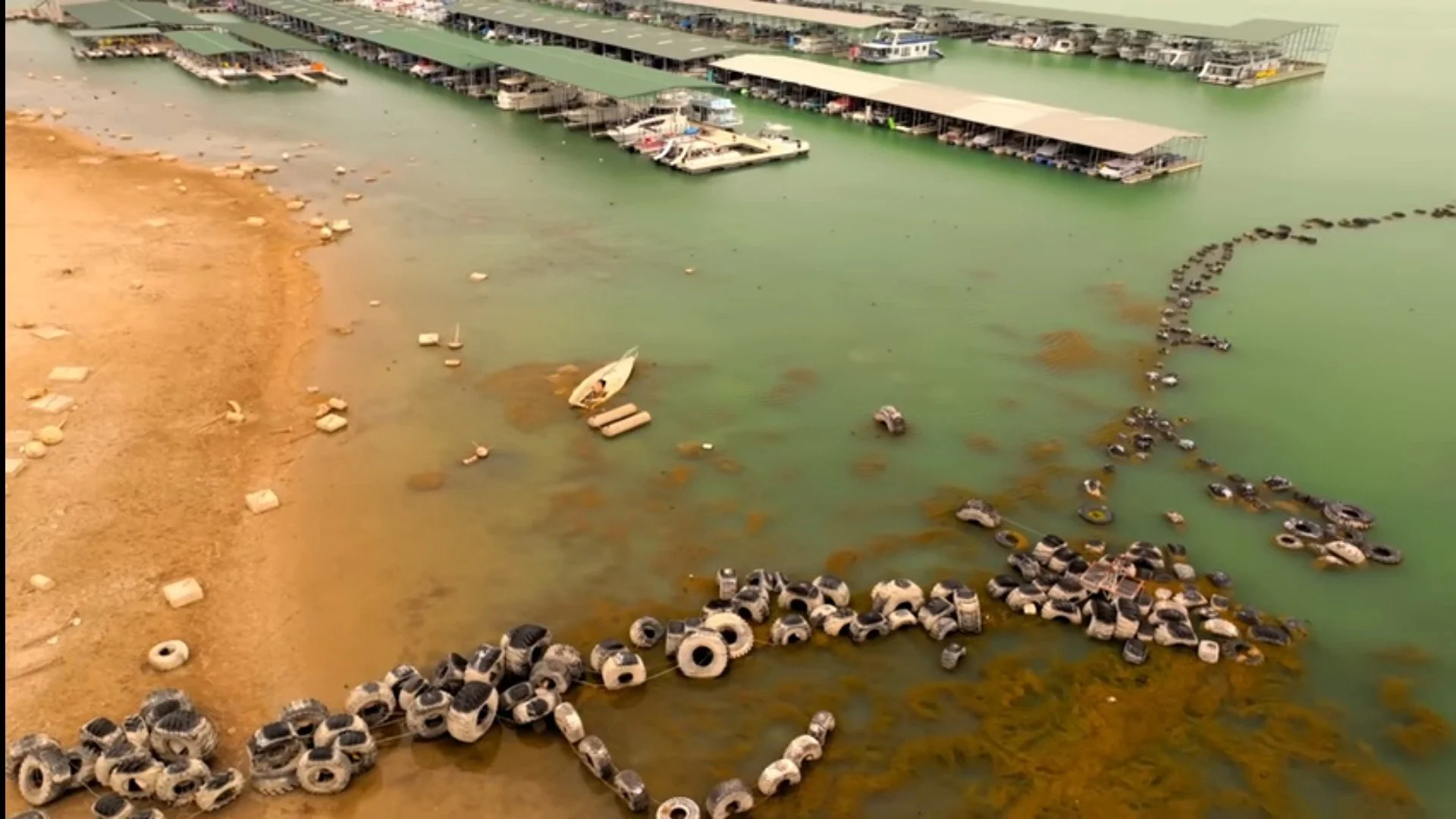
However, “Higher temperatures also lead to greater evaporation rates,” explain climatologists, proving true at Canyon Lake and Medina Lake, where white rocky shorelines have been evident, even though they are usually submerged. “We’re growing by leaps and bounds,” says President of the Canyon Lake Civic Association, Gayle Green. “Which means more water is needed to accommodate homes with families and businesses.”
Canyon Lake evaporated so much that Canyon Lake Fire/EMS lost five homes to fire when the water pressure from their water hoses was too low. Boat ramps have been restricted.
Medina Lake has risen due to recent rains, struggling with a “dead pool” status. Some Lakehills residents like Rachel Mulherin say they’ve been deprived of the lakefront views they pay for. “It’s the lake property we pay taxes on … for a water-front property. But that’s not what I have.”
Mulherin belongs to “Save Medina Lake.” She and fellow Lakehills property owner Henning Eilert-Olsen want the state to modernize area infrastructure, conserving water.
“There are some 300 canals,” says Henning. “But they are very old and very inefficient, and approximately 75% of the water is lost on its way from Medina Lake to farmers.”
Save Medina Lake proposes new wells to supply water to farms instead.
Texas’ wide and empty spaces have attracted the construction of data centers, servicing the increasing use of AI. SAWS reports fifty new such customers in Medina County, raising the ire of agriculture producers.
A dried-out Medina Lake
Water is a coolant in plant operations.
“What worries me… are seven new data centers planned around here, taking up water and space we don’t have,” says Mike Nickel, a South Texas Rancher residing in Castroville.
“We’re already under Stage Five drought restrictions, allowed 44% of the water we used to use. These developments might bring jobs, but without water, they won’t last—and they might push out the rest of us, who’ve been working the land for generations.”
Nickel has been forced to downsize his goat and cattle herd.
“The soil’s tired, and it hasn’t been the same since the canals from Medina Lake went dry,” says Nickel.
“I lived off 471 near what used to be Cliff, Texas, on the way to Medina Lake. The creeks and rivers always ran deep,” says Helen Marie Nickel, 92. She says in her 77 years there, San Geronimo Creek and Medina River were never dry.
“We swam in cold spring holes and never had to worry about water for the cattle. But about 15 years ago, everything started to change … I worry there won’t be enough water left for the generations to come.”
She’s right, as 2010 was Texas’ last most severe drought.
Texas is the second-largest state, so caring for the fate of tiny creatures living in our springs takes imagination.
Texas Blind Salamander (courtesy Edwards Aquifer Authority)
But the Comal Springs Salamanders are among “indicator species.”
When these pale fish show distress, biologists know springs’ water levels have dropped, signaling poor water quality for us.
“These blind fish and [salamanders] are very important,” says Hayden, “because in the long term, they’re an indicator of the health of the aquifer.”
Our state environmental agency, the TCEQ, oversees the western region of the recharge zone, scrutinizing building and development. Today’s building materials can be laden with chemicals, sinking into our groundwater. Concrete slab foundations stop rain from adding to our groundwater.
“The more we can do to address what is happening on the surface of the recharge zone, the better off we’ll be in terms of drinking water supply,” she says.
Drought played a big role in January’s Los Angeles wildfires. L.A. had had significant rainfall. But it stopped raining.
Senior Director for Aquifer Science Research & Modeling Paul Bertetti, says we face similar climate patterns.
“2021 was a year in which we received normal rainfall in the San Antonio region.”
Early 2022, the aquifer was “Stable,” falling to Stage 1. Then, no more rainfall came. 2022 ended as one of the driest years on record. That’s how fast our environment and climate changes.
The EAA “Critical Period Management Plan” ranges from “Stable” at 660 ft., to Stage 5, 625 ft. and below. ■
For the latest Edwards Aquifer levels, visit saws.org/your-water/aquifer-level-statistics