

By Ayesha M. Malik
Two Pakistani American Muslims from Houston – whose lives seemingly paralleled my own – were trailblazing on the silver screen and the local political scene, cutting through the darkness of a rising trend of anti-immigrant sentiment and Islamophobia and providing a refreshing glimmer of hope.
Brothers Saagar and Sakib Shaikh are a testament to the power of patience and perseverance.

Photography by Torry Sledge / Styling by Max Musas / Wardrobe courtesy Gautier
On one of the first couple of nights of Ramadan this year, I broke my fast, finished up my night prayers, and per usual, found myself surfing the streams of content curated to me. My algorithm splashed Deli Boys’ Hulu debut across my home page. Like a moth to light, I pressed ‘Play’ without a moment’s hesitation and locked in for the next six hours until I had to fast all over again.
Deli Boys, a dark comedy starring actors Saagar Shaikh and Asif Ali, centers two Pakistani American trust fund bros who uncover the sordid secret behind their father’s wealth when their Lucky Aunty (portrayed by the inimitable Poorna Jagannathan), takes the lovably lost goofballs under her wing.
Though I was not born with a silver spoon, nor am I heir to a convenience store-slash-cocaine empire, this show reflected me as the daughter of Pakistani immigrants whose every move was grounded in making their children’s lives better.
Absolutely devouring the 30-minute episodes, I watched the whole thing twice within the same week just because I wanted more. Infinitely bingeable and brilliant, there was finally a show themed around South Asian-owned gas stations and delis that didn’t need to hit on Appu-from-the-Simpsons-level stereotypes to be hilarious. Deli Boys gives me Tan France fighting in a full three-piece suit instead. Being 1000% obsessed, I told all my friends to watch because I need a Season 2 like I need water.
One hunger-induced Wikipedia rabbit hole all about the creator and charismatic co-stars later, I discovered Saagar Shaikh had an older brother after whom he’d he loosely modeled his Deli Boys character Raj (with Saagar also playing older brother to the titular character in Disney’s Ms. Marvel). Then, it clicked that his brother, Sakib Shaikh, was a candidate for District 8 city councilmember.
The gears of my mind began to spin out of control.
Not only are Saagar and Sakib real-life brothers, but their family moved from Alief – the same little diverse immigrant enclave of Southwest Houston that I’m from – to San Antonio. My hands were suddenly compelled by the faintest of hope to message the Shaikh brothers for an interview.
A Ramadan miracle was born. Just a few weeks later, I would be sitting across from Saagar and Sakib in the incredible Gravelmouth Gallery in San Antonio’s D.R.E.A.M. Arts District for a Scene In SA exclusive.
SHOCK TO THE SYSTEM
Having just barely recovered from meeting Alief-raised Palestinian American comedian Mo Amer (who filmed part of his Netflix series Mo down the street from my parents’ house), here I was all over again—ecstatic about feeling seen in the mainstream and having stories that reflect the themes of my life. Sometimes, it feels like a simulation with how much talent comes out of that corner of Houston: Saagar, Mo, Tobe Nwigwe, Lizzo and Miss Cowboy Carter, Beyoncé Knowles herself. It’s hard not to feel pride.
Saagar—already on a first-name basis with one of my favorite comedians—expressed, “I was actually talking to Mo the other day and we were talking about [how] we’re so broke and so hungry [in Alief] that we feel this pressure of doing something so special. Pressure makes diamonds.”
Aside from representation in entertainment, I felt a distinct power in having someone who looked like a member of my extended family involved in local politics, particularly where San Antonio demographics don’t skew particularly South Asian.
Coming from Alief – a place where Hispanic, Black, Asian, and mixed people collectively make up 92% of the total population, the brothers recounted their jarring family move to the Alamo City.
“It was definitely a culture shock. In Houston, where we’re from, my neighbors were African, Filipino, from Thailand, Pakistan, India, Nepal, Bangladesh, you name it. Every house was a different nationality,” Sakib described. “When we came [to San Antonio], it was pretty much an equal split of, on the Northside, Caucasian and Hispanic.”
“We moved from Southwest Houston to Northwest San Antonio. Ten, eleven months after we moved here, 9/11 happened.” Saagar recalled sitting in the classroom early that morning and felt the eyes turn. “We were the only brown kids in our school and it was the worst time to be the only brown kids in a brand-new school. That was my introduction to San Antonio, really.”
Saagar elaborated, “For the first 14 years of my life, we only lived in Alief. We didn’t have a lot of money [growing up] to travel domestically. Any time we traveled, we would just go to Pakistan. So, when we moved to San Antonio, I had thought [all of] America was just like Alief. I didn’t know there was a city two-and-a-half hours away that would be completely different.”
But of course, it’s been a long time since 2001 and Northwest San Antonio has seen a demographic shift, especially with the Wurzbach corridor of the Medical Center now boasting a significant Middle Eastern, North African, and Asian immigrant population and small businesses.
A District 8 resident for nearly 25 years, Sakib shared his excitement about the cultural designation of the area as the Silk Road Heritage District, in which he played a role during his time working in the District 8 Council office. “There’s grocery stores, restaurants, bakeries, clothing stores. [The designation] gives us guidelines on what we want future development on the street to look like.”
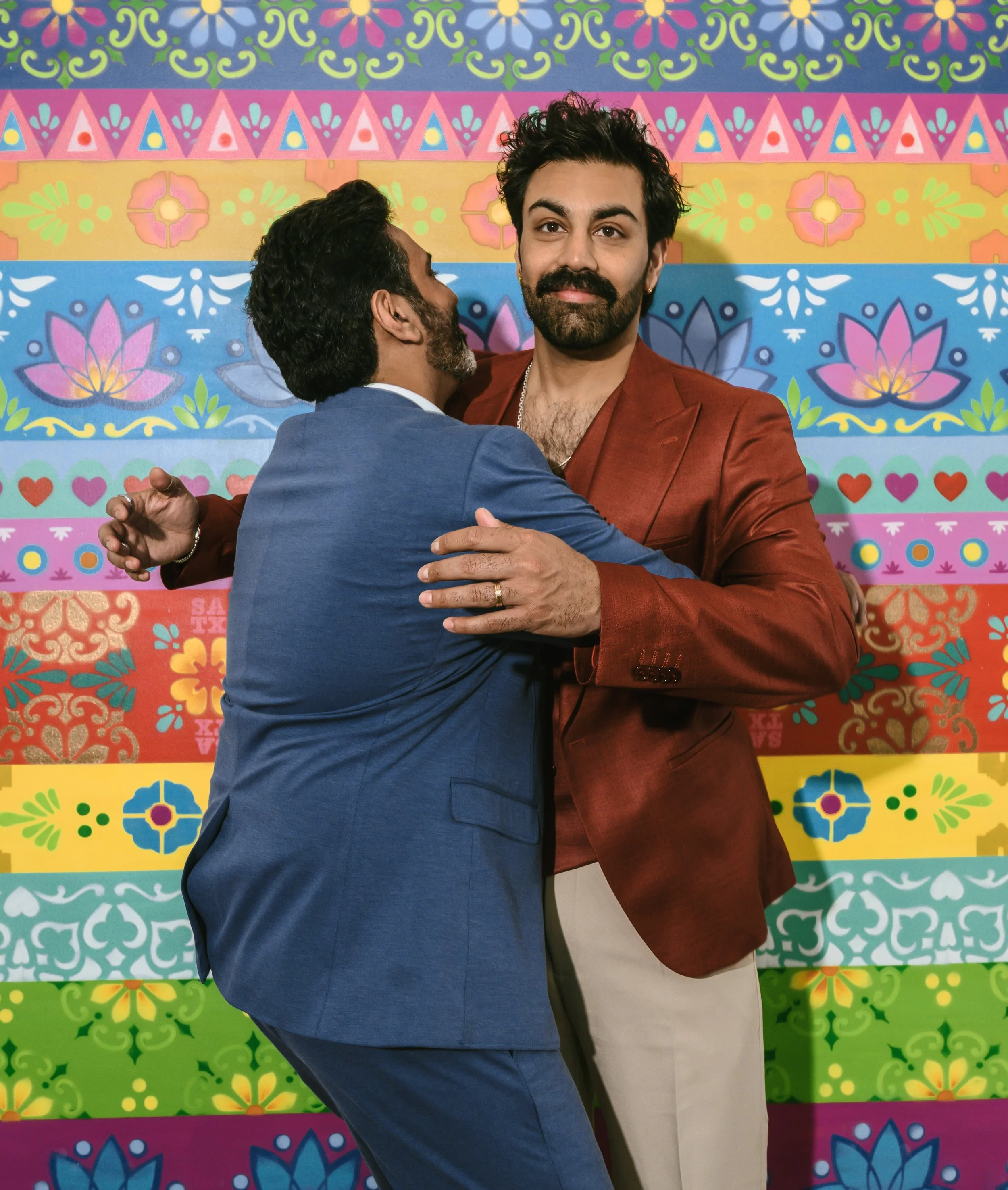
BROTHERLY LOVE
Set in Philadelphia, Deli Boys is a tale of two brothers whose entire lifestyles are upended when they are forced to navigate the sudden loss of their guiding star, their father Baba Dar (played by the legendary Iqbal Theba). Mir Dar, portrayed by Asif Ali, is the brown-nosing younger brother who is – by most measures – “doing it right,” having gone to business school and following in his father’s footsteps and aspiring to be CEO of Dar Co.
Older brother Raj Dar, played by Saagar, is the exact opposite—a bewaqoof (Urdu for “fool”) and a hedonistic degenerate fully kitted with a gold Allah chain. One walks with purpose and the latter aimlessly operates on pure vibes (and lots of drugs).
Saagar recounted numerous conversations with his Deli Boys co-star about reversing the roles: “I could have played Mir and [Asif Ali] could have played Raj. I can do both and he can do both; we’re trained as actors. While the show still would have been good, it would have been a different show.”
Truly, Saagar’s versatility can be seen in his role as Ms. Marvel's Aamir Khan—not to be confused with the Bollywood megastar by the same name—is a sharif (Urdu for “respectable”) Muslim momma’s boy substituting the blinged-out Allah chain for a modest long beard and providing moral guidance to his sister, Kamala Khaan. The characters were so different that I didn’t even recognize Saagar played both.
His inspo for the straight-laced Aamir and absolute jester Raj? Shockingly, still his own real-life older brother. Saagar set the record straight about his Ms. Marvel character: “[Aamir’s] also goofy.” Saagar channeled Sakib’s goofiness in his acting roles, relaying, “Outside of the house, [Sakib’s] the more polished brother of the three of us, but inside of the house, he’s the loudest one. That’s the version of him I’m most familiar with.”
Commenting on how he made the characters of Aamir and Raj distinct, despite the common source material, Saagar exclaims, “I got raaange, man! I’ve been all these people before in my life. You learn by watching people who are similar archetypes of those characters and you just try to emulate them the best way you can while throwing yourself into that mix. It’s a lot of mirror conversations and [figuring out], ‘What would my version of this person be?”
In the most endearing moment, Sakib beamed proudly about his brother’s craft. “He’s a legit trained actor. He talks about range, but that’s something he learned. He went to LA to pursue Hollywood the classic way. He was there 10 years before he got his first shot, so in that time, he was training. I didn’t understand [Saagar’s] work ethic until he pursued acting.”
But brothers are brothers. With two myself, I just know they had petty brother fights, so I asked them to share if they had any memorable ones that they laugh about now.
“Every day was a stupid brother fight,” Sakib responds.
Saagar jested, “And I don’t laugh about any of em!” before launching into how he still has an ongoing “You pushed me!”–“No, you slipped and fell!” argument with their youngest brother, even in adulthood.
But as Baba Dar reminds in Deli Boys, “When it comes to your brother, leave the tiff in the tiffin.”
FROM SLACKER TO ACTOR
Ribbing his little brother, Sakib teased that Saagar was a bit of a kaamchor (Urdu for “slacker”). “The Saagar I knew pre-LA was the one that worked at the family gas station, deli, but the thing is that’s not what he wanted to do. Once he found his calling, I saw a totally different Saagar.”
“I’d say my brothers worked there—I just got in the way. It was a terrible idea to want me to be there.” Saagar fessed up, admitting, “I did what I could. I’m not the type to wake up early. I sleep really late; I wake up really late. My dad was like, ‘You need to open the store at 6 AM.’ I was like, ‘6 AM?! Can I do 8?’ He was like, ‘No, this is a business!’”
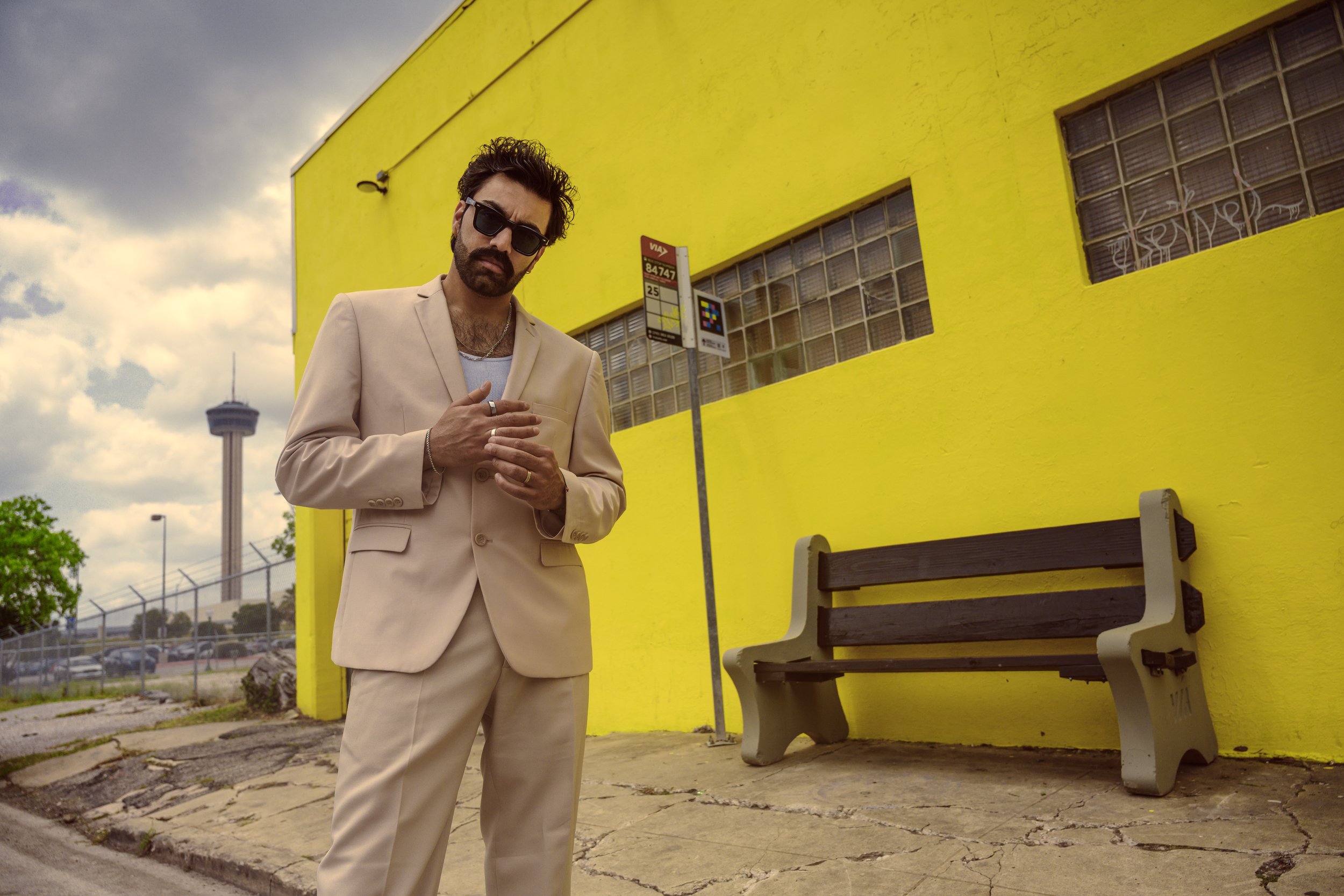
In the endless pursuit of pleasing the parentals, Saagar decided he would go to college at the insistence of his mother and with the assistance of older bro Sakib to help fill out applications. After spending three years at Northwest Vista, he joined some of his friends at UTSA. However, his passion for school never fully materialized, even though he eventually earned his Bachelor’s in Business Administration. “I was more interested in taking classes with my friends than taking classes at all.”
“I was a business major and I remember sitting in class one day [thinking], ‘This cannot be my life.’” After reflecting on the simpler times of grade school and brainstorming what he enjoyed doing, Saagar came up with theatre, but hesitated because he “didn’t have the audacity to dream of doing something different because it didn’t make money or it’s not respectable.”
That didn’t stop Saagar from typing the most meaningful Google search of his life: how to become an actor.
Thinking pragmatically, Saagar marched down to his academic advisor and asked for internship opportunities just in case acting didn’t pan out and he needed real work experience. Unbeknownst to him, he had an interview at a place with headshots hung on the wall a week later: a local talent management company, as kismet would have it. “I was like, that’s crazy! I just Googled last week ‘how to become an actor’.” He got the internship and was signed on as talent, discussing how he cut his teeth by doing local commercial auditions, self-tapes, and driving to Austin or Dallas multiple times a week to audition. “I would never do that today.”
Saagar gave his parents two years’ advance notice that he’d set out to follow his theatrical dreams in the City of Angels after graduating from UTSA.
“They thought [acting] was a phase. They were like, ‘We’ll see. Dekhenge.’ A year went by and I was like, ‘One year.’” Three months before graduation, Saagar moved out of his parents’ home into an apartment with friends. His parents thought that was the end of it, but he had a stubborn determination. Putting everything he owned in four trash bags into the trunk of his 2007 Toyota Camry, he set off to Los Angeles.
“I lived at home my whole life. I felt like I was abandoning my family to go do this thing that I didn’t know was going to pan out.” But after experiencing dissatisfaction with the traditional route, Saagar was even more resolute.
“The moment I started acting, I knew that I’d rather be broke, with a roommate – maybe I’ll never own a house, maybe I’ll never have a nice car, but I’d rather be pursuing the things that I wanted to do.”
In Islam, the concept of tawakkul is complete reliance on God and trust in the divine plan: the idea that what is written for you is already yours. For Saagar, his hard work and patient belief paid off. After a decade in LA and nearly giving up on the dream when COVID hit, his prayers were answered when he landed Ms. Marvel, and later, Deli Boys.
Though Saagar envisions starring in an indie romcom or writing, producing, or directing in his future, his primary focus is getting people to watch so Deli Boys can have a Season 2 (inshallah), so to everyone that reads this: boost those numbers and binge the whole thing on Hulu—Disney+ if you’re international.
SHAIKING THINGS UP
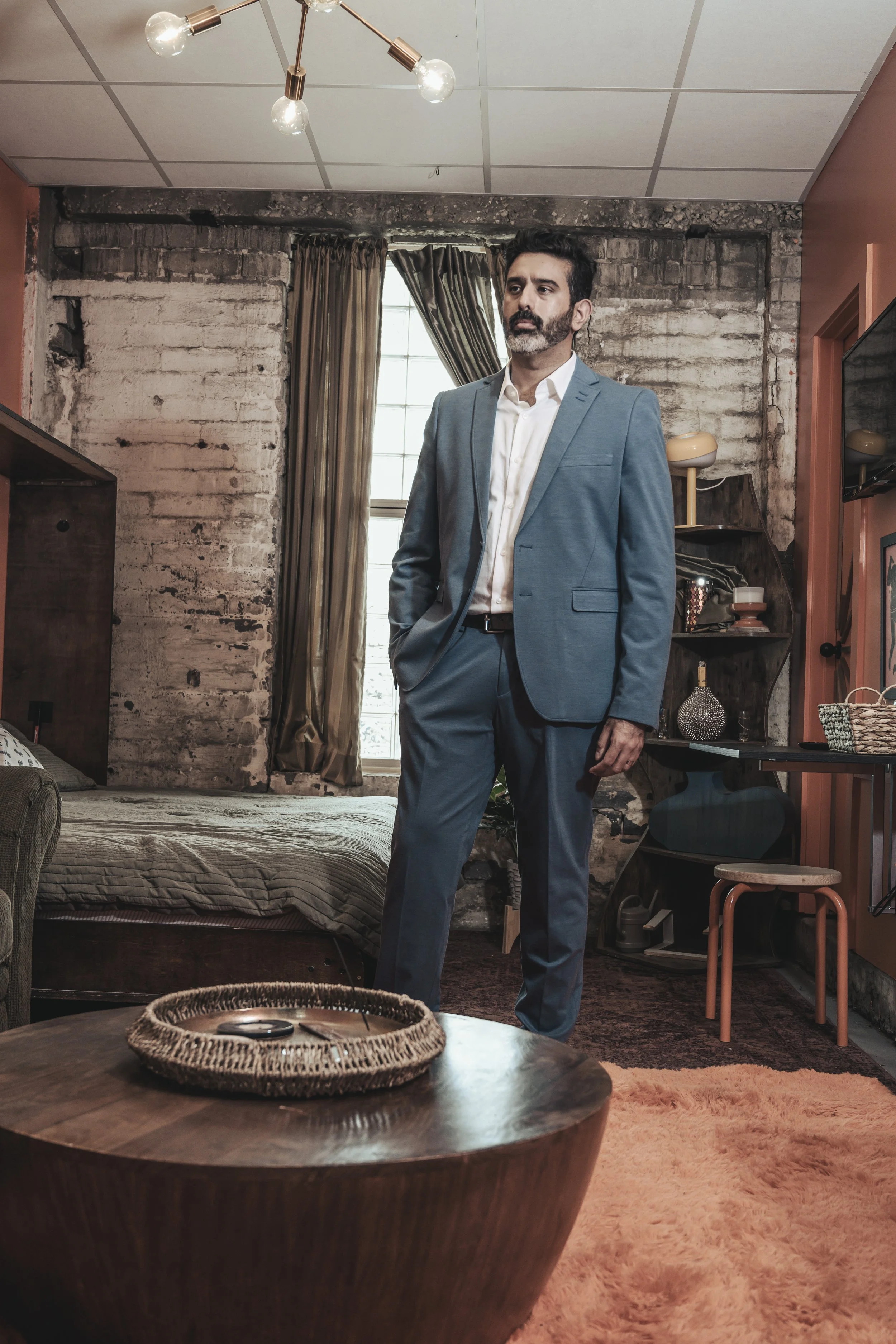
Politician is also among paths less traveled for Pakistani Americans. As ubiquitous as political commentators, pundits, and talking heads yelling at each other on TV news networks are in Pakistan, the same cannot be said stateside.
For every Indian politician or government official (Kash Patel, Nimarata “Nikki” Haley, Vivek Ramaswamy, Ajit Pai, and Bobby Jindal, to name a few, whom Saagar cheekily labeled “losers”), there’s only a handful of Pakistanis and the name recognition among those few is incredibly low, with the exception of maybe former FTC chair Lina Khan.
Fresh off the heels of Zohran Mamdani’s historic campaign (and recent clinching of the Democratic mayoral primary in New York City), the closest we could get was an Indian-Ugandan Muslim. Saagar put his hand over his heart and proudly proclaimed Zohran as “One of us.”
Sakib earned his Bachelor’s in Political Science from UTSA and Masters’ in International Economics. Being a double-major in PoliSci and Anthropology myself before going to law school, my mom 1) had no clue what Anthony-pology was and 2) showed great concern about what the job prospects were for whatever the heck a political scientist was.
Sakib explained his parents similarly questioned, “‘What job can you get with this [degree]?’ . . . Especially coming from an immigrant background where you’re supposed to do the stable path,” which in Asian families is often the prestige professions: doctor, engineer, lawyer—in that order, with lawyer at the bottom tier. “The truth is: at the time, I didn’t know what I wanted to do [with a Political Science degree]. I just knew I had an interest in politics and policy.”
Saagar added, “[Sakib] was the teenager that – when he got over his NBA dreams – if you asked him what he wanted to do or be when he grew up, he was like, ‘I’m gonna be president one day.’”
On pursuing political office, Sakib said it all stemmed from his interest in community organizing. After joining the board at his masjid, he endeavored to assume a public relations role, inviting political candidates, councilmembers, and state reps to the mosque to introduce them to the Muslim community in San Antonio and encourage the Muslim community to get involved locally.
“I hosted the first District 8 Candidate forum [at the Islamic community center] in 2017,” which was normally hosted by neighborhood associations and very sparsely attended. “We had close to 200 people at ours. It was the first time the mosque was considered a place where community affairs are discussed.”
Sakib poignantly discussed what politics is versus what it’s supposed to be. “We talk about politics and we think elections. We don’t think governance. We don’t think constituent services, which is what I did [working at the District 8 Council office]—making sure that city services are being delivered to the taxpayer in a timely and efficient manner. That’s what government is.”
KING KHAN
Now, I had to ask if Saagar and Sakib watched Bollywood movies growing up, especially since Saagar is an actor. To this, Saagar quickly reacted, “I know way more about Bollywood than I want to know. I know way more songs than I want to know, but I love it.”
The brothers began naming their Bollywood faves. Saagar started ratling off, “Shah Rukh Khan, Hrithik Roshan, Salman Khan, Aamir Khan…” before Saagar cut off his older bro.
“Salman Khan is not my idol.”
Sakib waxed a little nostalgic about the golden era of Khans of 1990s Bollywood, “You’re obligated to include him in that list…”
Shaking his head, Saagar quickly corrects the record. “You are NOT obligated to do that,” he laughed. “That’s a choice.” You see, dear reader, even if you know nothing about Bollywood, cancellations cross cultures—and Saagar’s gonna explain it all anyway.
In that moment, I found it heavily amusing that I’m witnessing two Pakistani brothers arguing about “Salman bhai”, a moniker given to the most controversial Khan since bhai means “brother” and Salman Khan has acted in a higher-than-average number of movies about brothers, including in the 1992 classic Hello Brother (which is a bootleg Ghost, except with a ghost Salman pestering his real-life older brother, Arbaaz). (Say brother one more time.)
Saagar lays out a timeline, solidifying his earlier statement that he knows way more about Bollywood than he wants. “Salman Khan fell off in 1999, maybe 2000. His best work was in 1994. Andaaz Apna Apna with Aamir Khan and it was only as good as it was because both of them were in it.” He shrugs smirking, “Some could say, if it was Aamir Khan and Shah Rukh Khan [acting in it], it might’ve been a better movie.”
As for the top Khan: For Saagar, it’s clearly the King Khan, SRK. Sakib named Aamir Khan (yes, the one in a whole host of media, but not Ms. Marvel) as the GOAT. (And no, none of the aforementioned Khans are related.)
But Saagar is a well of appreciation for the three two Khans. While Aamir is the true artist—best writer, director, producer—but that Shah Rukh has that undeniable superstardom. I mean, he’s got uncountable fans clamoring outside his mansion every morning hoping to catch a glimpse of him doing his trademarked open-arm pose on the balcony.
“That stance is getting so popular on TikTok,” Sakib added.
“He’s got the gravitas, the bravado. He’s just got that Tom Cruise charm.”
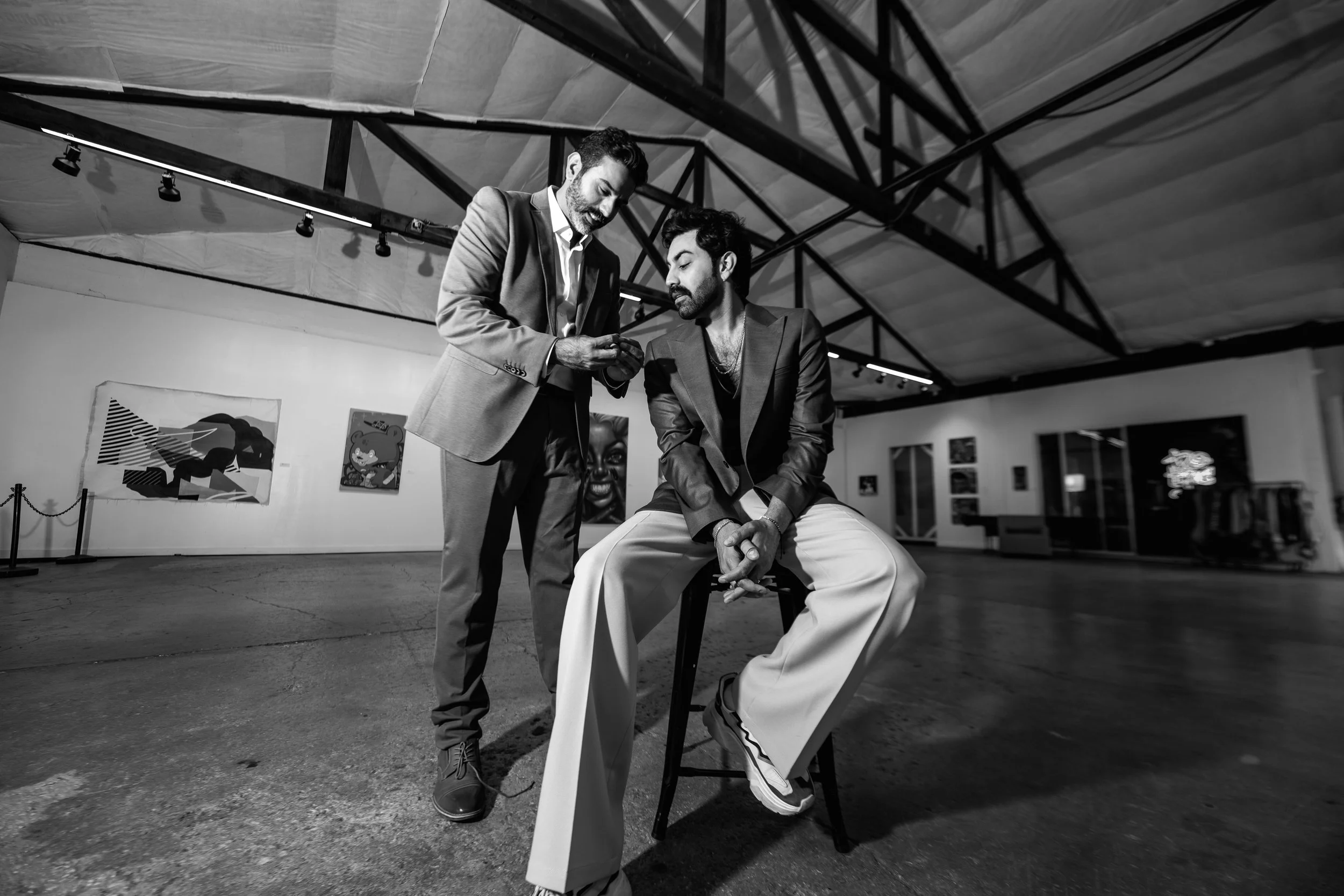
ABC DELI TO ABCDs
As American-born Pakistanis, it was important to tease apart the idea of ABCDs, or “American Born Confused Desi,” referring to the “Americanization” of South Asians born in the United States. The term is certainly divisive and inescapably hints at a perceived lack of competency with your own culture. The other side of the term is to describe one’s rejection of their country of origin, culture, or language in favor of American attitudes and practices.
Sakib attributed trauma, with others imposing an identity crisis on him by calling him an ABCD. “To imply that someone’s confused is to imply that they don’t know who they are. I know who I am. I’m just different. I’m not an ABCD, I’m an ABD.”
“It is what it is,” Saagar puts it. In the context of his character Raj, “Raj knows who he is. He wears it on his sleeve. He is far too rich to care what anyone thinks about him or how good or bad his Urdu is. He’s not an ABCD, but he works at ABC Deli!”
And sure enough: never pay any mind to the log kya kahenge because people will always talk—you just have to keep doing you. ■