

By Ayesha M. Malik
Photography by Nick Blevins
Brownsville native Tommie Gonzalez has lived three different lifetimes in the time we ordinary mortals live one. After learning the marketing biz from his early career in television, founding his own independent record label, and jetsetting around Europe, Tommie came back to San Antonio, guided by his passions, to launch a wildly different career: barbering. Despite being a citizen of the world,
Tommie is Puro SA .
With his flagship Puro Handsome Barbershop nestled in a cozy space right next to the Majestic Theatre in beautiful downtown, Tommie is an ambassador of local culture. His shop with two locations and his five years of solid success are a testament to how much he loves this city and the people in it.
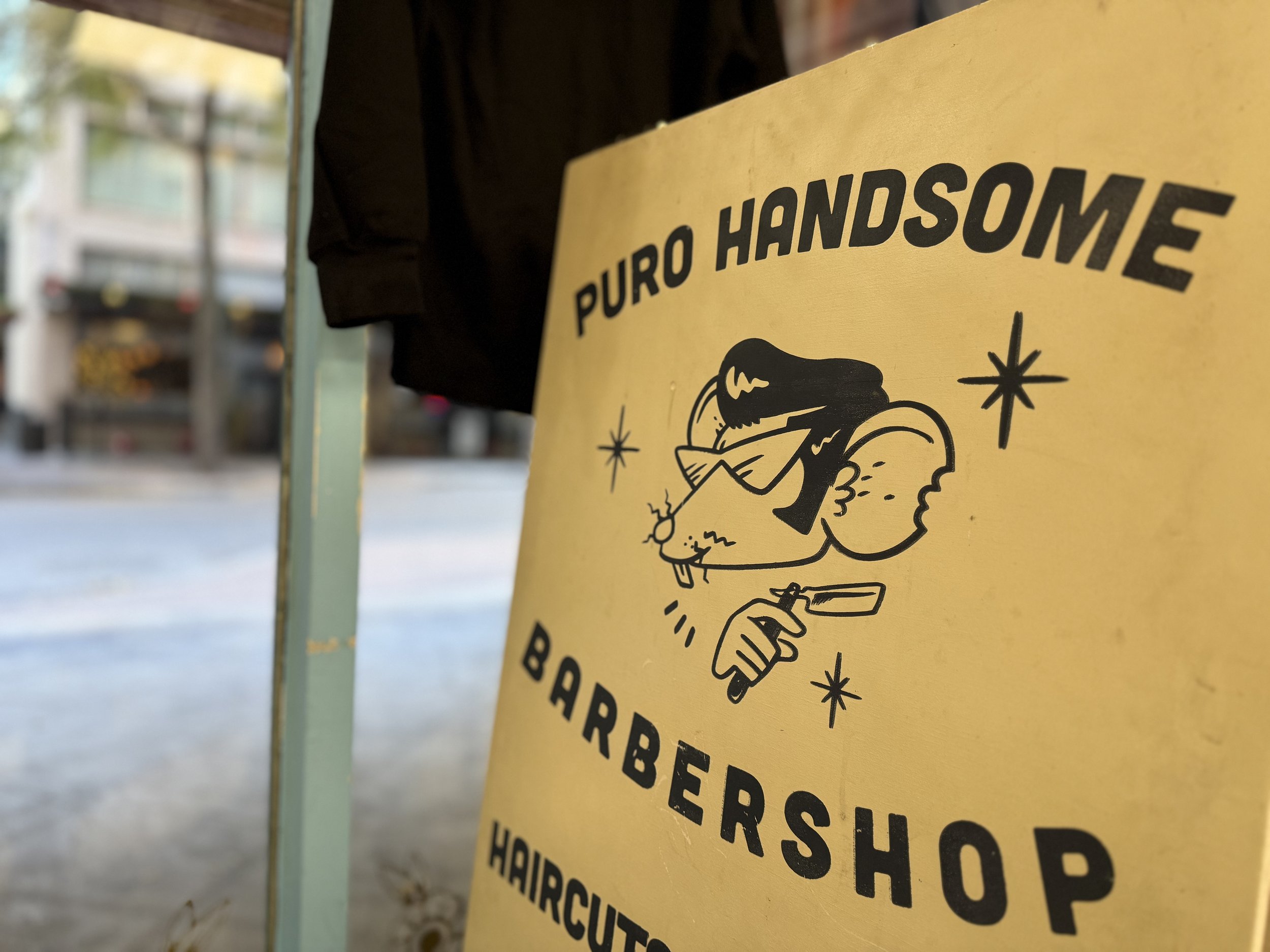
The perfectly coiffed “greaser-rat” branding adorning the large windows was designed by local artist Shelby Criswell (@shelbycriswell). He frequently commissions artist Gilbert Martinez of Forreal Art (@forreal_art), who designed this very magazine’s Spring 2024 cover art and whose art was recently featured at the Whataburger Museum of Art pop-up at SXSW 2025. The art covering almost every square inch of Tommie’s space are all by locals, including Scene In SA’s Winter 2024 Puro pick, Ray “Tattooed Boy” Scarborough (@tattooedboy123). (In fact, the bathroom has so many Tattooed Boy prints that Tommie lovingly refers to it the unofficial Tattooed Boy (f)art museum.) And it works: Tommie naturally attracts the kind of clientele he aims to cultivate.
Puro Handsome Tommie
“I still very much run my shop like a record label. Subpop, Sacred Bones, SST, and all these classic punk record labels created a scene around their brands.” He noted that one of his favorite experiences during his time in the music industry was seeing at a big Scandinavian music festival how diligent they were about putting local merchants on showcase for visitors. “There’s tons of places to go put hair on the floor. I’m really proud of creating that image, brand, and culture that makes people want to be here, to be a part of it.”
Tommie learned about the fundamentals of culturally-relevant marketing and branding by cutting his teeth in television and music. “I had started working in television when I was 17. It was her fault,” Tommie laughs, as he nodded toward his mother, Sandra, whose initial protest was broken by a proud smile. “It was pretty much ‘Will you please get a job?’ and she ragged on me so bad that I walked out of the restaurant [where] we were having dinner. I went to the TV station next door and was like, ‘Are you guys hiring?’”
“I was always that kid that if I had outside chores, you’d have to lock the door because I’d come back in and turn on the TV,” ribbing that his mom deployed this tactic and pushed him to work by saying ‘Do you think you’re gonna find someone to pay you to watch television?’ Sandra, like basically every mom, remembered it differently—playfully rebuffing any notion she did anything but gently encourage her son. “I actually did find someone who paid me to watch television. Spite is a good motivator,” Tommie joked.
It was all love – things fortunately worked out for him. As he was getting a tour from the man who would later become his mentor, Tommie relived being on set with his dad and uncle as they taped with the late legend Johnny Canales. “My family on my dad’s side were musicians in the Tejano music scene. When I was six or seven years old, we were recording episodes of The Johnny Canales Show at KVEO in Brownsville.”
Surely enough, Tommie landed the gig and a life-changing mentorship at the same TV studios he used to run around in as a kid. “I think it kind of endeared him to me,” he reminisced. The young Tommie was green to the media scene, but his future mentor saw it as a benefit, citing that at least it meant he was a clean slate who had no bad habits to break.
“My mentor ended up becoming a regional director for Sinclair [Broadcast Group] and he guided my career. He believed in me at a very young age and gave me really cool challenges that I wasn’t afraid of.”
Indeed, Tommie left an impact from his time in television. Tommie helped create the template for broadcasting high school football. Sixteen years later, Thursday Night Lights is still presented in the San Antonio market through local sponsors.
“It’s become a huge local business money maker. I was part of the crew that created the outline on how to do it, like how to find sponsors, put together a schedule, and produce this from start to finish. It was really cool to work for such a big company to show me big ideas [and incorporate] local business culture and attitude.”
Tommie’s time in marketing continued with his foray into music. “I think I had my early midlife crisis where I wanted to turn my hobby into my career.” Between working full-time at the broadcast station and simultaneously spinning the plates of booking shows for bands three times a week, hosting and promoting them, and running sound, Tommie was able to get to a level where he could afford to start his own indie record label.
“Big mistake once it became work,” he lamented. He recalls sitting with international show promoters from India, Korea, Japan, and Mexico, drinking expensive Norwegian beer and brainstorming ‘How do we create more music business?’ instead of a record business.
Photo courtesy Tommie Gonzalez
At a posh meeting at Berlin’s Soho House Hotel with digital music juggernaut Spotify and music distributors nearly six years ago, Tommie realized his heart just wasn’t in it anymore and walked away. The music landscape changed too dramatically with the dawn of viral audio and TikTok—physical media sales became increasingly challenging. “When I sold TV, I saw value in it. Once I accepted there was no value in digital music, it became a chore. It’s just another marketing tool.”
After boldly rejecting the ultra-rapid commercialization of the industry he once loved, Tommie realized, “The only thing in the world that you can’t download is a haircut.”
Sitting in his favorite beer garden in Germany at the time, Tommie recounted that his experiences getting a haircut in Berlin sucked. “I could go to an Aveda or Paul Mitchell or something salon and a very rude German man in a threepiece suit is gonna give me a terrible haircut for 70 Euros, or I could go to the Turkish barbers in my neighborhood who will give me a high-and-tight bald fade, no matter what I asked for.”
Tommie spent a lot of time flying to London and Manchester because of his label’s relationships with BBC indie channels in the UK. “As soon as I checked into my hotel or Airbnb, the first thing I’d do is find the nearest barber. Like, I just got off the Tube, took the bags off my back, and have an hour, two hours before I have to meet up with my artists or do radio interviews or sound check. It was a great experience every time. Like, ‘How are you, sir? Whiskey, beer, espresso, water, fizzy water? No appointment? Have a seat; we’ll be with you as Photo courtesy Tommie Gonzalez soon as we can.’ This was my ‘me’ time in this cool little part of the world—I started looking forward to the barbershop experience.”
At the time, he had not considered being a barber, but the appeal of owning a barbershop was growing as his desire to be a record label owner waned. “I was just like, if you’re gonna be a barbershop owner, you’ve got to be about it, too. You don’t want to be that asshole that’s the owner and doesn’t know how to cut hair. Nobody’s gonna have any respect for you."
Cutting to the chase, Tommie set out to cut hair. On one weekend walkabout in Olympia, Washington after having the best cup of coffee of his life, his curiosity about barbering led him to Google ‘barber schools near me’, and lo and behold, Olympia Barber School was literally less than a mile away from where he stood. He immediately enrolled as part of the next cohort and the rest was history.
When his mom’s health began declining, he moved back to San Antonio. Tommie was working at another locally owned barbershop when he decided he wanted to set up his own red-andblue striped pole. Just before the COVID-19 pandemic, Tommie used to walk past the Majestic and the adjacent retail space that used to be an old electronics store. “One day, it was empty and had a ‘For Lease’ sign. I went across the street, had lunch at The Palm, and called.”
After he was asked to submit a proposal for what he wanted to do with the space, Tommie’s new dream was coming to fruition. Thus, Puro Handsome Barbershop was officially born. “The greatest compliment is when people are like, ‘This place has been here for 30 years’ or ‘It feels like this should have been a barbershop. Was it a barbershop before you took over?’” Roll in genius marketing and there’s a formula there.
Eclectic, inspired design abounds inside of Puro Handsome Barbershop
How was Tommie going to distinguish his shop in San Antonio, a very saturated market with clients who are fiercely loyal to their stylists? “What are you doing to make sure that whoever’s in your chair is not going to go anywhere else? That’s the idea with the hot towels and scents: to create a physical, visceral experience that you can’t get anywhere else. I wanted to bring the closest experience to a London barbershop.”
Tommie also personalizes the experience by communicating with his clients to ensure they get exactly the haircut they want. “I’ve gotten awful haircuts that still keep me up at night. I don’t want to do that to you, but a lot of young men don’t know how to communicate.” He encourages them to show him a picture, give him a vibe of what music they like, or open up to him about what their hobbies, schedule, or routines are like, so he can give them an inspired haircut. “Not only is it protection for our scalp and skin, but hair has been adornment and a form of expression since the beginning of time.”
Not only have his clients appreciated his expertise, but Tommie has also been recognized by HairCut Harry, a popular YouTuber specializing in the binaural sensory experiences of scissor cuts and wet shaves. Tommie’s videos have garnered over a million views from all over the world. “I’ve had people come from Dallas, Tulsa, New Orleans, the Valley. It blows my mind that people plan their trips around the fact that they’re gonna get a haircut with me.”
The HairCut Harry effect was measurable. “I remember sitting in barber school watching HairCut Harry. I’ve had a 15 percent increase in business since the videos came out, which was pretty cool because I was already pretty solidly booked, so for me to see that kind of increase at a time I had kind of plateaued was noteworthy.”
Tommie says that even though he knows it can be overused, puro is a powerful word unique to this market, so he embraced it. Being from a border town like Brownsville, Tommie straddles two distinct cultures. An amalgamation himself, he wanted to hit that bilingual, colloquial resonance. “I knew early on I didn’t want something like Tommie’s barbershop because my goal is not to be behind the chair forever. I think we have probably created one of the more original and authentic uses [of puro]. You don’t have to be fake or keep a story up. As you evolve, your business and your brand is still very much you.”
Tommie’s personal line of pomades and beard balms
And speaking of brand, Tommie launched his own line of pomades and beard balms. “The product was just something that is my DIY spirit of punk rock. As a disciple of branding, I’m that dork nerd that subscribed to branding expert newsletters and reads books about great brands and their cultures. It always goes back to authenticity. It didn’t make much sense for me to create noise for other brands [in my shop]. I think there’s great products, but they weren’t hitting the right note in here.”
As someone who has a great deal of clients who stay in downtown hotels and travel, Tommie noticed a discrepancy in the market. “I found that that three-ounce, 100-milliliter TSA-approved limit was populated by salon-type products and not barbering, which still had an archaic ‘more product, bigger, better, super-size, good value for your money’ [vibe].” Manufactured in Texas, Tommie’s products allow folks to travel in puro style.
As he strives to provide a holistic experience for his clients, Tommie recognizes when San Antonio businesses try to do the same. He recently went to an eye doctor appointment for his mom that he considered puro. “The doctor knew how to communicate with her. You could tell he’s spent some time in the market and he hadn’t just been assigned straight out of optometry school and it wasn’t a chain.”
For Tommie, puro is 100% authenticity to yourself and in service to your community in every circumstance. “I felt forced and inauthentic in a lot of situations [in the music business], and I don’t ever want to do that again. I’m really grateful to have made it five years—that’s a really legitimate milestone for a local business, especially considering we didn’t even cut hair for the first year because of COVID.”
In the face of a rapidly changing downtown, Tommie is motivated by being a small, locallyowned business in the middle of mammoth, national brands like Jimmy John’s and Voodoo Doughnuts. “I fear that it’s going to be harder and harder for locals to make a mark or name for themselves in their downtowns. It’s an honor to be this little brand in this big, beautiful downtown. If I don’t dig my heels here and continue to fly the puro flag, I don’t know who else will.” ■