

By Jules Aldaz
Walking into the Woodlawn Theatre, I felt that familiar pause before something meaningful begins. Excitement, yes, but more like a readiness.
The Animalis Fabula Film Festival took place at the historic Woodlawn Comedy Theatre in San Antonio, and from the start it was clear this was not a festival built around spectacle. It felt quieter than that. Intentional. This is the kind of event where people come prepared to watch, to really listen to the stories being told and to have it resonate with them long after the lights come back up.
At a festival centered on animals and the natural world, Animalis Fabula also made room for a deeply human story with the documentary on Dr. Temple Grandin. It felt like a natural extension of the programming, since these films are ultimately about how humans relate to the world around them. How we protect, misunderstand, exploit, and sometimes fight to preserve what we once ignored. Animals are not background characters. They are the reason these stories exist.
The Woodlawn Theatre was the perfect home for it. This historic theatre opened in 1945 and the building carries decades of shared history. There is a magical feel about watching films in a space that has held many collective moments before. It reminds the audience that storytelling was always meant to be experienced together.
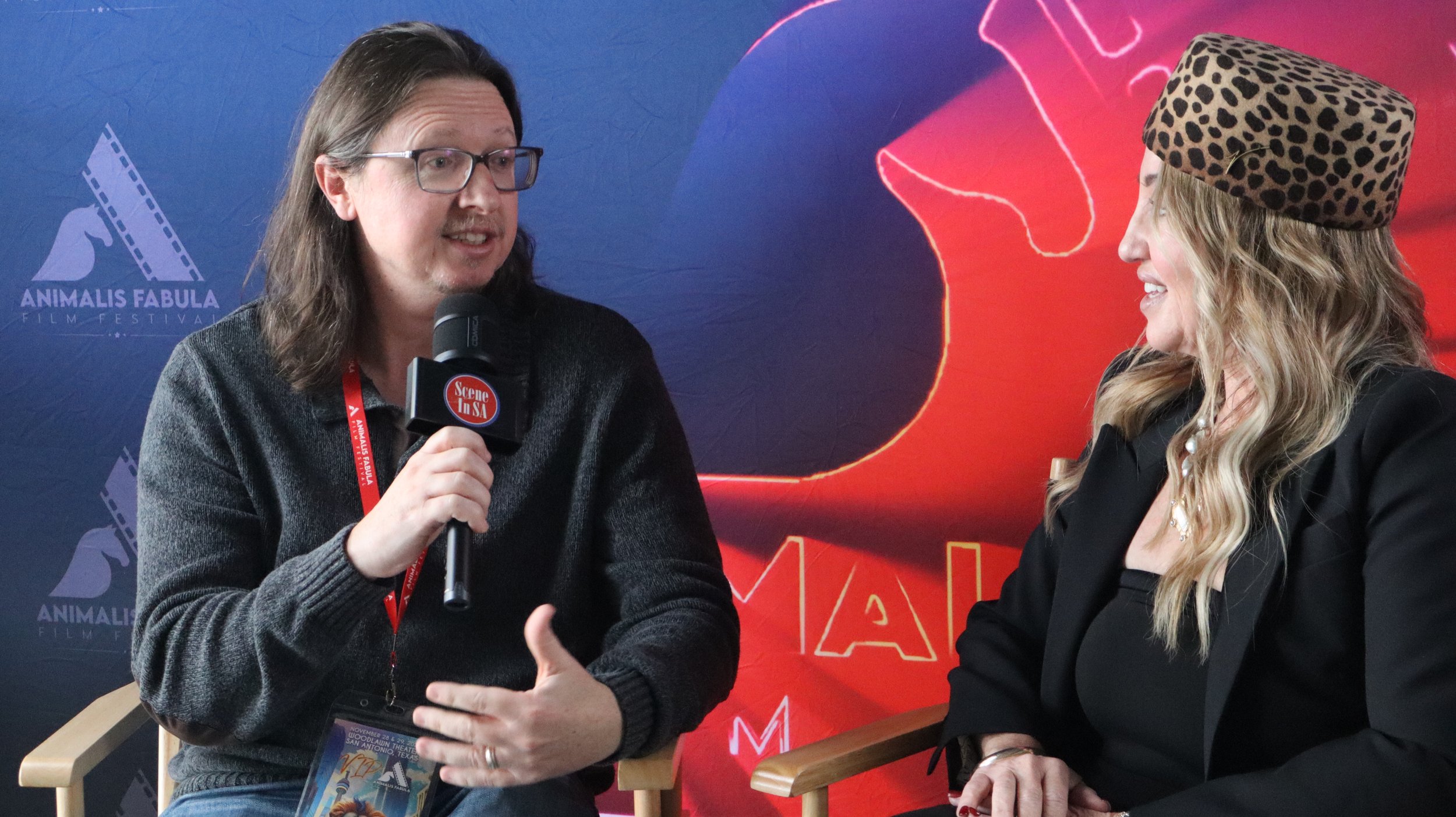
CJ Goodwyn (left) being interviewed by Scene in SA’s Jules Aldaz (right)
Showing up still matters
One of the first people I spoke with was San Antonio filmmaker CJ Goodwyn. He was not there to promote a project, nor make an appearance. Instead, he was there to support the festival and the people behind it.
That idea surfaced again and again throughout the festival. People were not showing up to be seen. They were showing up because they believed in what was happening in that room.
CJ spoke about the importance of attending festivals and screenings, especially in cities like San Antonio. Community does not build itself. It takes people choosing to be present.
He is currently in post production on Sherlock Holmes: The Fall of Watson and developing a gothic television series titled Eternal Pursuit, but what stayed with me most was his advice to aspiring filmmakers. Make what you want to make. Not what you think will sell. Not what you think the audience expects.
He spoke honestly about the realities of independent filmmaking noting that no matter where the location that funding is always a challenge. Distribution requires caution. Protecting your work matters. But he also talked about the advantages of creating in Texas. Access to locations. People willing to help. The ability to make something meaningful without a massive budget if you are resourceful.

João Queiroga - Best Documentary at Animalis Fabula: Shepherd Boy

Through the eyes of a stray dog, Shepherd Boy offers a tender, yet unflinching portrait of life on the margins of society. Left to survive on the outskirts of Doha, Shepherd Boy navigates the harsh desert that has become his home. His journey — marked by love, loss, and resilience — echoes the struggles of those pushed to the edges of a rapidly changing nation. Blending lyrical storytelling with raw documentary observation, the film becomes a quiet metaphor for society’s forgotten souls.
It set the tone for the festival. Ambitious, but grounded
Learning to see what we overlook
A movie that lingered in my mind was The Invisible Mammal, directed by Kristin Tieche. This documentary focuses on bat preservation and women in science. It never comes across as clinical or didactic. Instead it feels intimate almost serene, in the manner it progresses.
Kristin explained that the film’s origins began well before any cameras were present. Years back as a graduate student in upstate New York, she spent an evening outdoors and noticed the sky teeming with bats. Having been raised in the Bay Area she had never truly noticed bats until then. That evening surprised her. Left a lasting impression.
Subsequently as she started researching white-nose syndrome and the damage it was inflicting on bat populations throughout North America, that recollection resurfaced. What made it more impactful was recognizing that the epidemic started close, to where she had attended school. She caught herself questioning if the bats she had observed before were still present.
That inquiry ultimately brought her to Texas. The movie was filmed at Bracken Cave in San Antonio and at the Congress Avenue Bridge in Austin. Watching those scenes projected on a screen was captivating due, to the stunning cinematography — witnessing thousands of bats emerge simultaneously — the noise, the motion. It changes your perception of them. Fear doesn’t hold power once you grasp what you’re observing.
There’s a moment in the film where the camera lingers on a bat’s face. Up close, unguarded. Someone sitting near me whispered that they never thought they’d describe a bat as cute. It was said almost in disbelief. That small reaction felt like the kind of shift this film was quietly aiming for.
When stories meet in real life
Animalis Fabula does not let stories end when the credits roll. The festival intentionally brings nonprofit organizations and animal welfare advocates into the same space as the films.
Throughout the festival, those conversations felt just as important as what played on screen.
Catherine Lara, with K9 Service With a Twist, spoke about training service dogs for veterans and teaching incarcerated women animal handling skills that lead to employment after release. Her work centers on rehabilitation through responsibility.
Kati Krouse, founder and executive director of Bears, Etc. Bears and Exotic Animals and Reptile Rescue and Sanctuary, spoke about exotic animals that end up displaced or neglected. Tigers, exotic cats, birds. They are often displaced not because of cruelty, but due to misunderstanding. Her organization works closely with law enforcement and animal control to educate, intervene, and find appropriate placements.
I also spoke with Julie Ann Marchbanks of God Dog Rescue and Monica Caballero of the San Antonio Feral Cat Coalition. Their work reflects the everyday reality of animal welfare in San Antonio.
Julie Ann has been rescuing animals for decades. God Dog Rescue has saved tens of thousands of dogs and, more recently, cats, transporting them across the country for adoption. The film 25 Cats From Qatar, shown at the festival, mirrors the kind of rescue work happening locally.
Monica’s approach at Feral Cat Coalition is prevention, deploying a simple, but effective strategy: Trap, spay, neuter, return. She spoke openly about scale. There are countless feral cat colonies in San Antonio, which are known to decimate bird populations. You cannot save them all, but every effort matters in protecting our local ecology and valuaing animal welfare.
That idea echoed throughout the festival.
A voice that ties it all together
One of the most meaningful moments of the festival was the presence of Dr. Temple Grandin, whose work has shaped modern animal welfare and transformed how we understand visual thinking.
At the Woodlawn Theatre, a documentary about her life titled An Open Door screened at the festival, a follow up to the original HBO film that first introduced many people to how she thinks and works. Being there in person mattered. Her presence connected decades of progress to the conversations happening in the room.
Dr. Grandin spoke about thinking in pictures, not words — about being an extreme visual thinker and how that way of seeing the world allows her to understand animals, who don't deal in abstractions like humans.
“Animals live in a sensory world,” she said. “You have to get down into their shoes and see what they are seeing.”
She spoke about how animal handling has improved over time, not just because of better equipment, but because of changes in management and accountability. One of her proudest accomplishments has been creating simple scoring systems that helped companies like McDonald’s, Burger King, and Wendy’s improve animal welfare without rebuilding entire facilities. Repairs, maintenance, nonslip flooring, and a shift in attitude made measurable differences.
Her message extended beyond animals.
Dr. Grandin spoke about the teachers who helped her as a child with severe autism and delayed speech. She credits hands on learning, strong mentors, and people who saw her potential before she could articulate it herself.
Her advice to young people was direct. Get off the screens. Try out different careers. You have to try things to really know what you like and what you don't like. Do real things. Learn how to solve problems.
To educators, she emphasized the importance of recognizing different kinds of thinkers. Visual thinkers. Mechanical thinkers. Pattern thinkers. The best work happens when these minds collaborate.
Understanding how people think differently does not divide us. It helps us work together.
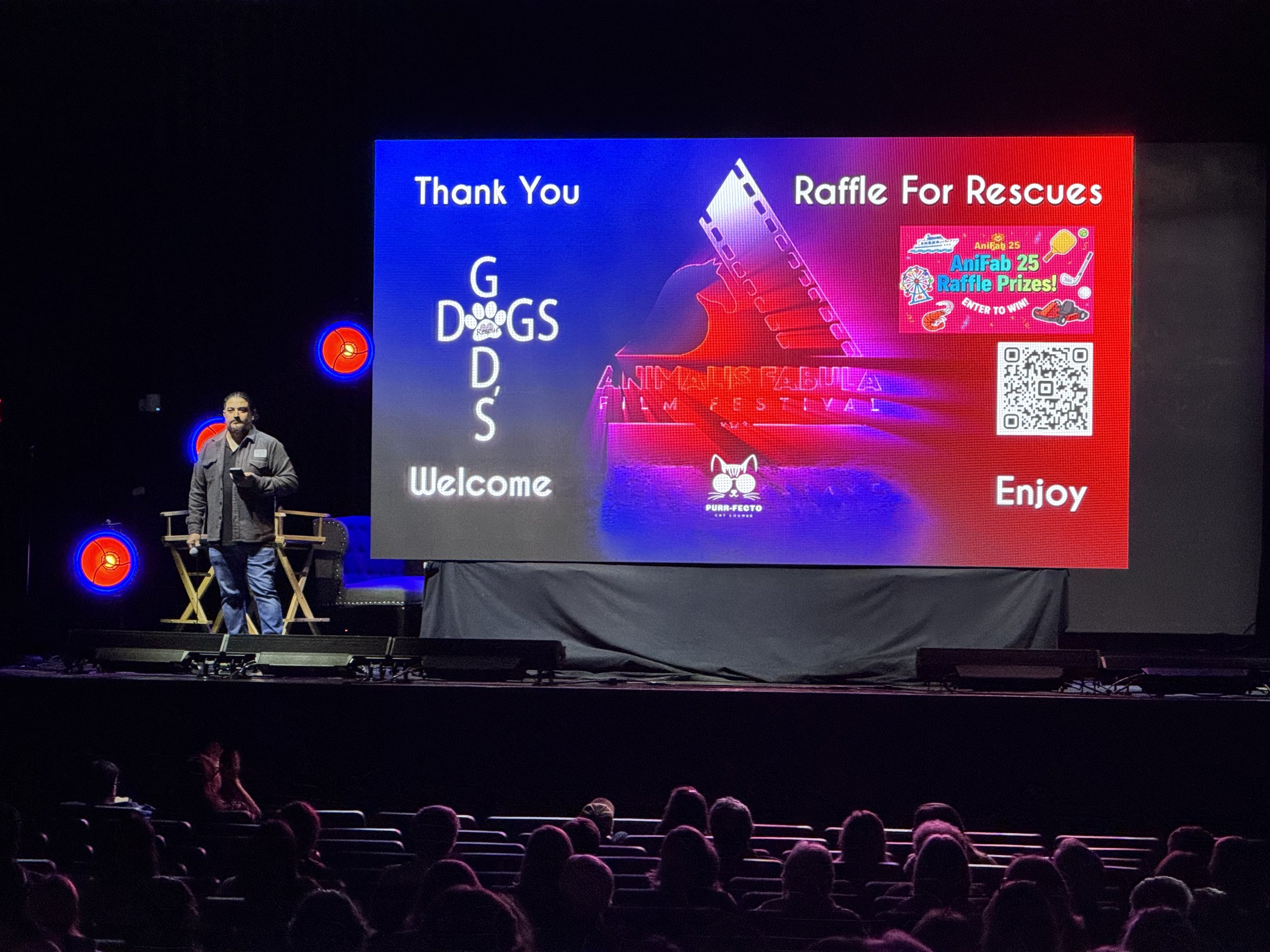
The thinking behind the festival
At the center of Animalis Fabula is Tom McPhee, the festival’s founder and also the founder of Texas Media Maker. Spending time with him helped the larger picture come into focus.
When I asked what films shaped him early on, his answers came quickly. Old Yeller. Born Free. Films that treated animals as beings with meaning, not props. Those early impressions stayed with him.
Tom speaks often about visual thinking as lived experience. That perspective is reflected throughout the festival. Animalis Fabula is built around observation, empathy, and allowing stories to unfold without forcing conclusions.
He talked about curiosity. About asking questions. About early conversations with Steven Spielberg that were less about admiration and more about understanding process. How careers start. How people learn.
For Tom, storytelling is a way to help people see differently. When people understand how others think, whether human or animal, empathy follows.
Animalis Fabula works in San Antonio because this city understands community. It understands gathering. It understands stories that are layered, imperfect, and human.
The festival does not tell people what to think. It invites them to observe.
As the event came to a close, what stayed with me was not just a particular film or conversation. It was the quiet shift that happens when awareness settles in.
You leave seeing bats differently. You leave understanding rescue work more clearly. You leave thinking about education, empathy, and how different minds solve problems.
“Animalis Fabula does not ask people to save the world — it asks them to care.”
And sometimes, that is exactly where change begins. ■
For more information on future Animalis Fabula film festivals, please visit animalisfabula.org.
