
Lasting Echoes
By Betsy James Cooper
Research Contributed by Kaylin Ledford
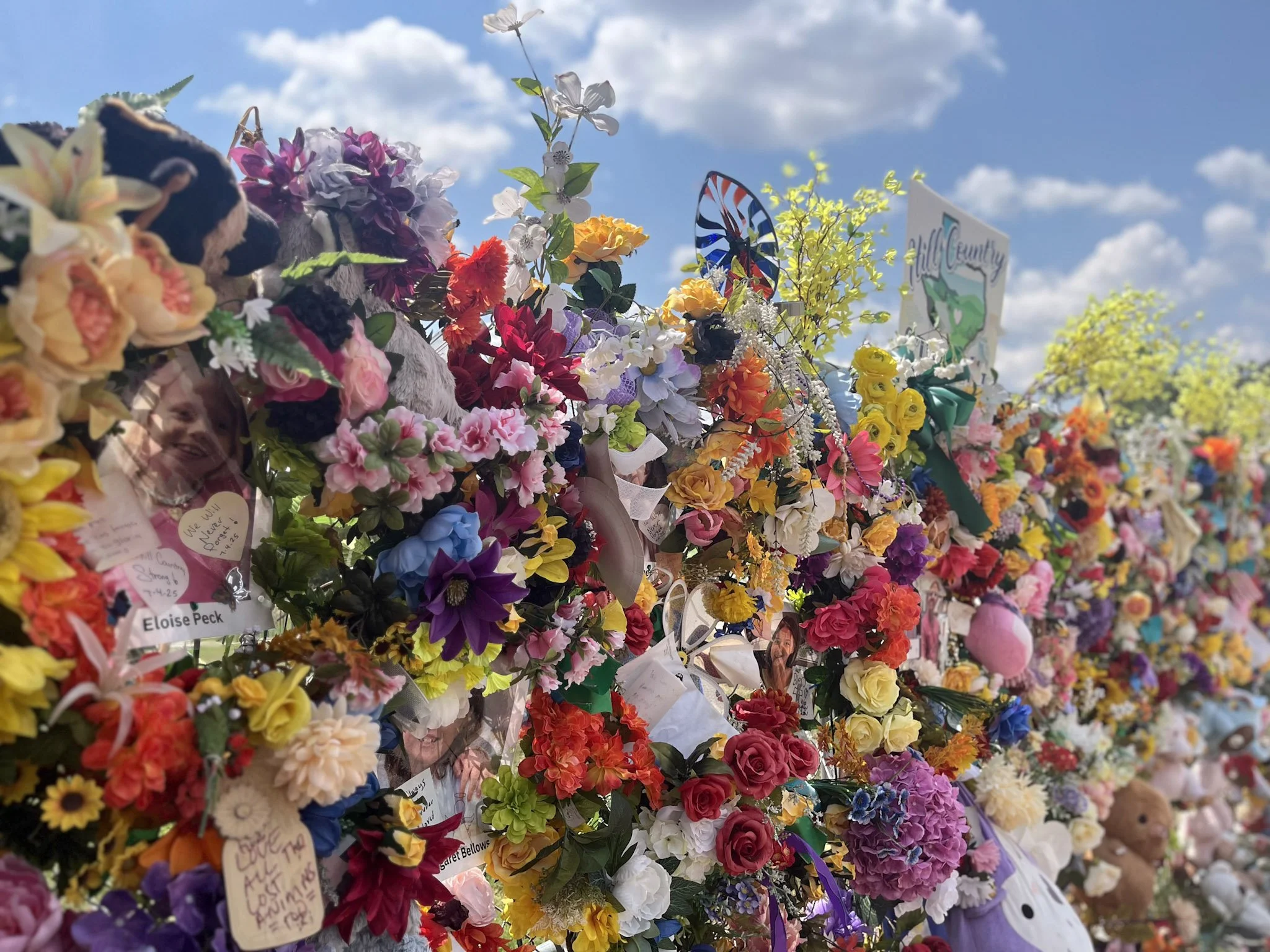
A memorial commemorating lives lost in the deadly Texas Hill Country floods in July
On July 4, as people were preparing for a fun-filled holiday with family and friends in celebration of Independence Day, a dangerous storm had stalled out in the Texas Hill Country over the Guadalupe River Basin. This wasn’t your average summer storm. In fact, it ended up being what’s called a “100-year flood;” one so severe that it has a 1% chance of happening in any given year. Areas susceptible to flooding during a 100-year flood are called “Special Flood Hazard Areas” or “floodplains.” This area of Texas is known as “Flash Flood Alley.”
When I woke up on the morning of the fourth, I felt well rested because it had been raining for the majority of the night. I love sleeping during a good rain storm, and besides, we needed it. I figured the sky would clear in plenty of time to celebrate the holiday outdoors. A group of friends were gathering for what we call a “pool hang.” The fourth of July was a somewhat annual event at this family’s home attended by many generations over the years; but this year was different. The rains persisted into the afternoon. The Texas sky was gloomy with ominous, dark clouds. It didn’t look as though there was going to be a break in this weather pattern any time soon. Nevertheless, I ditched the idea of a swimsuit, grabbed my umbrella, and headed to the party.
Upon my arrival most people were hanging out in the kitchen. Around 3:00 in the afternoon, we gathered around a large table in the sunroom to share conversation and catch up with each other over holiday hot dogs. Several people had their cell phones at hand, scrolling through their news feeds. Suddenly, a loud gasp! One girl at the table exclaimed, “Oh no… There is a flood in the hill country and 27 girls at Camp Mystic have been swept down the Guadalupe River.” The conversation quickly turned to tragedy, as questions and disbelief swirled in our heads. The hostess of the party attended Camp Mystic as a young girl. Another friend’s daughter started going to Camp Mystic when she was eight years old, and later became a counselor. A few tears were shed with so many unanswered questions. How could this happen? Why weren’t they rescued or warned of the wall of water headed their way? How many people are missing?
Later in the day, more information was released about the devastation that was unfolding along the Guadalupe River. The rains started at 1:14 am while campers, vacationers, and local residents were still asleep. The waters rose so rapidly that most people didn’t have a chance or the time to head for higher ground. The rising waters reached 26 feet in under an hour, creating an avalanche of rain water washing away vehicles, trailers, homes, cabins, wildlife, people, their belongings, and their beloved pets.
Before I go any further on the research I’ve done, you may be asking what experience I have to be writing this article. My background is in forensics with over 30 years as an investigator. I’ve worked with law enforcement agencies across Texas in the search for missing persons, and as a forensic artist I have reconstructed the faces of the deceased for identification purposes. As the Executive Director of the Heidi Search Center I’ve worked with many families, and have organized and conducted searches for the missing. I’ve also volunteered on countless other searches over the years. I have devoted my adult life to locating the missing to help bring them home to their loved ones.
The waters rose to 26 feet within an hour, full of branches and debris
The search and rescue teams began arriving as early as Friday July 4, with others arriving in the following days. The first to respond were local, state, and federal personnel, as well as international teams from Mexico. A report by NPR said that local teams were already in place and responding as the waters rose. They had 14 helicopters, 12 drones, and nine rescue teams actively involved. CNN reported that FEMA search and rescue teams were deployed later, with some teams arriving days later due to a delayed approval. H-E-B mobilized a convoy of aid two days before FEMA arrived, highlighting the gaps in the official response.
Just days into the search, trained search and rescue dogs were actively deployed. Horses, including those from the Austin Police Mounted Patrol, were brought in to help navigate the difficult terrain along the riverbanks, primed as it is for disaster with steep slopes, limestone bedrock, and poor soil absorption. Torrential rainfall has no place to go but downward, washing away anything and everything in its path.
The equipment used in the search and rescue mission was unique to the terrain they were covering, including airboats, kayaks, scuba diving equipment, excavators, bulldozers, satellite phones, AI-powered sonar technology, and even some devices to view aerial imagery to detect what other sensors couldn’t.
The Guadalupe River “Flash Flood Alley” is considered one of the most dangerous flood zones in the U.S. and has an extensive history of major floods that occurred in 1932, 1978, 1987, and 2002. In 1987, ten girls drowned during a flash flood at the Pot O' Gold Christian Camp near Comfort, Texas, when a bus carrying them tried to evacuate and was hit by a wall of water from the Guadalupe River.
On July 5, heartbreak struck the close-knit community of Camp Mystic as director Dick Eastland was confirmed to have died while attempting to rescue campers from the devastating flash floods that swept through Kerr County early Friday morning. Eastland, a beloved leader and longtime pillar of the private Christian summer camp, is being remembered as a hero who gave his life trying to protect the young girls in his care. One message posted to social media read “There are still around 20 missing girls. The stranded group was rescued. Unfortunately, Dick Eastland passed away after the rescue. He was a great man and truly cared for his girls and his camp.“
Hearing this heartbreaking news about Dick Eastland hit me hard. I felt helpless knowing what was happening just an hour away from me. I was chomping at the bit to get out to the hill country. Unfortunately, people were being warned to stay away, but I did hear from a fellow investigator that hundreds of volunteers were gathering and teaming up at different locations to search on their own. People just wanted to help out with the search, and volunteers aren’t used to being turned away.
One week after the flooding, I felt that I had held back long enough. I grabbed my fluorescent orange search vest and my hiking boots, and headed for the Texas Hill Country. A friend and I drove out to the low water crossings and high bridges along the Guadalupe River; the devastation was unbelievable. An NPR report stated “More than 850 people have been rescued so far – many by helicopters, officials said. Of the dead, 68 of them were in Kerr County… the death toll includes forty adults and 28 children, Sheriff Larry L. Leitha said.” It was hard to imagine what happened to all those people, and what they must have heard, thought, and felt as they were being washed away. Parked on a bridge near Rebecca Creek, we sat in the car with the windows down. There was an eerie silence. Gone were the sweet sounds of nature. I got out of the car and walked down towards the river, where the roaring sound of water was a stark reminder of why we were there. Rebecca Creek is some 70 miles down the river from Camp Mystic, but it was still close enough to see the devastation left behind from the powerful waters. I took photographs of tall, mangled trees that were bent over sideways, and piles of debris that lined the banks of the Guadalupe River. Before leaving, we noticed a tall pole that we couldn’t identify. It was around 30 feet tall and looked like it had a few solar panels and possibly a speaker at the top. Could this be a flood siren?

This map shows the locations of flood sirens as of September 2025, courtesy Paul Kahl
Once I identified that this strange looking pole was indeed a flood siren, I knew that I needed to investigate further. I then found out that there aren’t any sirens in Kerr County. How could this be true? Evidently, the community of Comfort installed a siren and had no fatalities from the same storm. Campers at La Junta (the brother camp to Mystic) were moved to higher ground in time with no fatalities. A news headline read: “Brave Counselors at All-Boys Camp Saved Hundreds of Kids from Texas Floodwaters”
The Guadalupe River has always been a natural treasure and at the same time a hidden danger located in the heart of the Texas Hill Country. The following facts and information outline some key points that may have contributed to the overall devastation of the flooding on July 4th, 2025.
There aren’t any flood sirens to activate in Kerr County, despite requests.
Camp Mystic doesn’t have an emergency evacuation drill in place for campers and counselors. A state inspection noted that the camp had a flier posted by each cabin door.
At the time of the flooding Camp Mystic wasn’t clearly documented on the FEMA floodplain maps.
The youngest campers at Camp Mystic are placed the closest to the river.
Campers and counselors weren’t allowed to carry cell phones with them while attending camp sessions.
A flash flood warning was issued at 1:15 am, when the river level at Hunt, Texas was measured at 7.64 feet.
River levels rose to 26 ft. in less than an hour and up to 37.5 ft. by 5:00am. (waterdata.usgs.gov)
At Camp Mystic not all campers were successfully evacuated.
Hill Country camps operate from May to July, during the peak flooding season.
With all of these red flags, I found out that Camp Mystic passed a state inspection on July 2, just two days before the tragic flooding. Earlier, I mentioned that this flooding was labeled a “100-Year Flood;” I find this interesting, considering that Camp Mystic has been in business for 99 years. Parents have entrusted their children to Hill Country camps all these years, assuming safety systems were in place. My hope is that new laws, regulations and changes in state inspections can be implemented so that children can continue to experience summer camp in the Hill Country.
As of early September 2025, Camp Mystic plans to rebuild and reopen following the deadly floods on July 4, 2025. After the disaster, which destroyed many of the camp's buildings and killed 27 campers and counselors, the owners created a recovery fund and communicated their intent to rebuild.
However, significant changes are required for the camp to operate again.
In direct response to the tragedy at Camp Mystic and other locations, Texas Governor Greg Abbott signed new summer camp safety legislation into law on September 5, 2025. To comply with the new rules, the camp must implement major changes:
Relocate cabins: The new laws prohibit camps from placing cabins in floodplains. Camp Mystic must move or rebuild the cabins that were in harm's way, particularly those used by the youngest campers, which were close to the Guadalupe River.
Install warning systems: The camp is required to operate real-time weather radios and emergency public address systems that are functional even without an internet connection.
Improve emergency plans: Camp Mystic must create a detailed emergency plan that includes an evacuation strategy. The plan must be submitted to the governor's office for approval.
Mandate staff training: All staff and volunteers must be trained in emergency procedures.
High costs: Some lawmakers and camp operators have expressed concern that the new safety regulations will impose a heavy financial burden that could threaten operations. The camp may not have enough funding for full compliance.
Pending legal action: The camp could also face a barrage of lawsuits from the families of the victims. Legal experts have noted that if the camp failed to act on National Weather Service flood alerts, its insurance coverage could be jeopardized.
My dear friend Laura Marbut’s daughter Mica Moran attended Camp Mystic in 2006 and was there for 11 years. I contacted Mica recently to ask her about her experiences and thoughts about the tragic flooding.
“I made many lifelong friends at Camp Mystic. There was something so special about the time we spent together because we knew it would end and we would have to wait a year to experience it again. In an environment with no phones, internet or ‘real’ world distractions, you are forced to slow down and enjoy every second; to live in the present.
The relationships that are built in that kind of place are just different. My best friend from Camp Mystic is Emmie Anderson. Sometimes we go years without seeing each other, but always pick up where we left off. I know she’ll be in my life forever, no matter what.”
Camp Mystic gave me so many tools that I still use to this day. I believe I’m more understanding of why things are the way they are, and wiser because of the things I learned there. I know how to love myself, and to trust that there is a greater plan that sometimes we do not understand. I know that it is okay to make mistakes, and it is okay to grow.
When I heard about what happened at Camp Mystic my heart broke for the girls that had to experience that. To know that their summer at camp had to end. To know that something so horrific had happened at the place they call their home away from home, their place of safety and comfort. To know that Dick died did not even seem real – I didn’t believe it at first. I spent the past few months connecting with old friends, looking at old pictures, and remembering all of the wonderful things about Mystic. It was truly heaven on earth.”
After the July 2025 floods, donations poured in, with over $100 million raised. Meanwhile, state leaders, including Governor Abbott and Lt. Governor Patrick, pledged that Texas will now fund the sirens before next summer, closing a dangerous gap in preparedness.
As the waters of the Guadalupe recede, they leave behind not just a landscape devastated by mud and debris, but a community forever changed by sorrow. The river, so often a source of joy, celebration, and life revealed its other, more horrific side. The lives lost to its powerful and unforgiving currents are a reminder of the immense fragility of our existence,
In the wake of this disaster, the true spirit of this river emerges not from the riverbed itself, but from the resilience and compassion of its people. The courageous rescuers, the heroic searchers, and the communities’ countless acts of kindness show that while the flood may have taken so much, it could not wash away our humanity.
The Guadalupe River has always been a scene of tranquility and peace yet sometimes displays its powerful, unforgiving force of nature. It will continue to provide a source of happiness for many years to come. But our hearts will forever treasure the souls of those who were recently lost. Their names will eternally be etched into the history of this sacred River of Angels. ■